
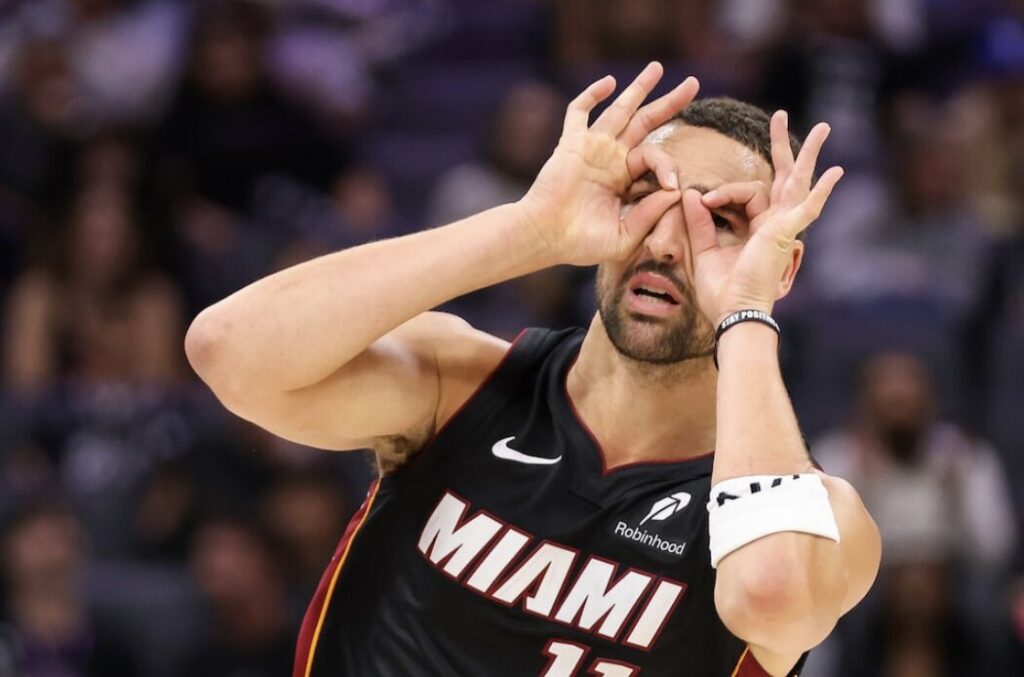
The Miami Heat are slowly, but surely, rounding into form, as they are winners of nine of their last 11, improving to 9-6 on the season.
While we are still very early into the season without a large sample of games (or datapoints) to work with, what are a 15 notable statistics after 15 games? Let’s examine!
Offense:
2.06 assist-to-turnover ratio (T-3):
Skinny: Behind Davion Mitchell’s exceptionally strong start to the season, Miami sports one of the best assist-to-turnover ratios in the NBA. Mitchell leads the league in assists with a 3.65 AST:TO ratio, the fifth-highest of anyone who have dished out at least 75 total assists. The only players who are better include Immanuel Quickley, Fred VanVleet and Dyson Daniels.
Given the rapid, borderline chaotic, pace that Miami (and Mitchell himself) plays at, the Heat’s 14.0 turnover percentage (7th) is impressive — and important for their output offensively.
35.2 3-point percentage (16th):
Skinny: To me, this is both good and bad.
The good is that the Heat still have some margin-for-error to improve. Andrew Wiggins is shooting well below his career average (33.3); Tim Hardaway Jr., who’s currently out of the rotation, is shooting 22.5 percent; Bam Adebayo is shooting just 24.5 percent on rather low volume (3.3 3PA); Bobby Portis is barely shooting 30.6 percent from deep. Lastly, they’re shooting sub-35.0 percent on open threes and sub-39.0 percent on wide-open threes, which I don’t think lasts.
The bad is the exact same thing could be said about the inverse, although to a lesser degree. Davion Mitchell and Klay Thompson are shooting 43.7 and 43.2 percent, respectively; those are likely 80-90 percent sustainable, although I have more faith in Thompson maintaining that percentage; Pelle Larsson is shooting 47.1 percent from deep, albeit on just 2.8 attempts per game.
At the end of the day, there are more shooters who are due to positively regress instead of regressing entirely.
33.1 free-throw attempt rate (5th):
Skinny: Outside of Jimmy Butler, the Heat have struggled to consistently get to the free-throw line over the last five seasons. Only Cody Zeller, Norman Powell and Bam Adebayo have attempted at least six per 75 possessions since the start of 2022-23.
With Antetokounmpo’s addition, Miami has shot up in both free-throw attempt rate and free-throws attempted per 100 possessions. They are top-5 in both FTAr and attempts per 100 per possessions thus far. Antetokounmpo, Adebayo and Pelle Larsson both have FTAr’s exceeding 52 percent. Before then, only Butler had a FTAr exceeding 45 percent since 2021-22 (min. 200 FGA).
116.7 transition offensive rating (27th):
Skinny: After the Miami Heat were third in fastbreak points per possession last year, they are currently No. 8, sandwiched between the Los Angeles Lakers and Minnesota Timberwolves. However, they are still middle-of-the-pack in transition points added per possession (+2.8) while being a bottom-five team in transition offensive rating, per Cleaning The Glass. The decision-making outside of Antetokounmpo in transition has been quite murky, which hopefully improves as time goes on.
Giannis Antetokounmpo’s usage over last 11 games (31.7):
Skinny: Over the Heat’s first four games, Antetokounmpo’s usage was 35.5 percent. Over the last 11, it’s 31.7, which would be the lowest of his career over a full season. Miami spent the first four games — for the most part — trying to utilize last year’s offense with this year’s roster. The Heat’s newest superstar tried too hard to knife his way through the opponents’ “walls” built for him. Now, he’s trusting his teammates more while being utilized more as a screener and at the dunker’s spot. He’s also built a formidable two-man partnership with Klay Thompson — similar to what Bam Adebayo did with Duncan Robinson.
1.0 points per possession in pick-and-roll (ballhandler) — 93rd percentile:
Skinny: The Heat still rank dead last in ball-screens, but they are the third-most efficient offense in such possessions. They are T-2 in points per possession by the ballhandler (93rd percentile) with the highest effective field goal percentage and the eighth-highest score frequency. Miami must continue to lean into this area more with how dangerous Antetokounmpo and Adebayo are at getting downhill.
24.7 paint touches per game (18th):
Skinny: Miami had the fourth-fewest paint touches last year; it has elevated its league standing a little bit, moving to No. 18. Teams are still packing the paint, but it is doing a better job creating and exploiting advantages on DHO’s, ball-screens and pin-downs. I have also liked how much the Heat are trying to create early offense by running the floor, as well their cutting in the halfcourt, which helps when you have a player (Giannis) who draws five pairs of eyes.
102.8 offensive rating in halfcourt (2nd):
Skinny: As they’ve developed more synergy, Miami’s halfcourt offensive rating has become one of the best units in the NBA. They are 2nd in halfcourt offensive rating, according to Cleaning The Glass. They are also sixth in halfcourt frequency. Their production and efficiency has gone hand-in-hand with their increase in pick-and-roll and DHO usage in recent weeks. When Mitchell, Thompson, Antetokounmpo and Adebayo all on the court together, their halfcourt offensive rating is 103.5, which ranks in the 91st percentile.
95.3 clutch offensive rating (23rd):
Skinny: In fairness, only five of the Heat’s first 15 have been clutch games — when the point differential is five points or fewer at any point in the game’s final five minutes. In those situations, their offensive rating has been quite poor. The go-to scorer (Giannis) is obvious, but they haven’t quite figured out how to optimize him in those moments, in part because they haven’t many of them yet.
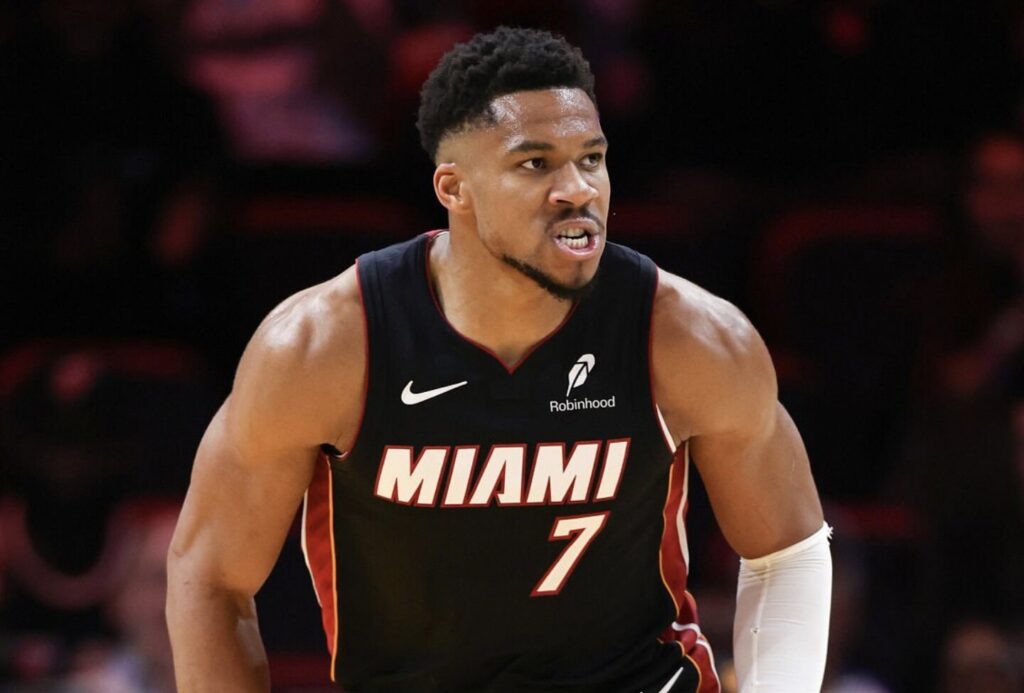
Defense:
68.3 Defensive Rebound Percentage (17th)
Skinny: While the Miami Heat have been an elite defensive rebounding team (76.5 DRB%; 98th percentile) with Antetokounmpo and Adebayo both on the court, they have been a mediocre defensive rebounding team this season. They are substantially worse on the glass with just one of those two alongside Bobby Portis, whose motor and boxouts have been catastrophic. Over the last week, their activity on the boards has been poor in its entirety. That must be cleaned up; rebounding wins championships.
102.8 defensive rating in halfcourt (29th):
Skinny: As good as they have been in the halfcourt offensively, they have been just as bad defensively. Their rotations and closeouts have been fairly sloppy all year, although there’s been some improvement in those areas lately. A large part of that is also due to teams seemingly making every single open three, which we will discuss shortly. Over the Heat’s six-game win streak, their halfcourt defense rating is T-18 (100.7).
44.8 3-point percentage allowed on wide-open threes (30th):
Skinny: The Miami Heat have been the unluckiest team in the NBA in wide-open threes. Defensively, teams are shooting 44.8 percent on wide-open attempts, which the NBA categorizes as attempts with the closest defender being at least six feet away. That’s over one percentage point greater than the next-best 3-point percentage (Hornets – 43.7 o3P%). Miami also ranks in the bottom-half in long-range efficiency allowed on attempts where the closest defender is both very tight (0-2 feet) and tight (2-4 feet) from shooter, per NBA’s shot track data.
18.9 deflections per game (9th):
Skinny: Since the Hornets game on Oct. 24, Miami has leaned into a more aggressive switch-heavy scheme, elevating its disruption. It is top-10 in deflections per game through 15 games, including seventh since the start of its 11-game win streak (19.1), behind only the Detroit Pistons, Lakers, Atlanta Hawks, Dallas Mavericks, Toronto Raptors and New Orleans Pelicans. The more disruptive they are, the better, especially because of how dynamic they can be in transition with Antetokounmpo.
45.3 paint points allowed per 100 possessions (9th):
Skinny: A staple of Erik Spoelstra’s scheme has always revolved around paint prevention. That has remained the case this year, as they are ninth in paint points allowed per 100 possessions (they were 12th last year). With two of the league’s best at defending the paint, I expect them to maintain that top-10 standing.
1.1 points per possession in isolation (7th percentile):
Skinny: Teams have hunted Thompson, Hardaway Jr. and some of the team’s lesser defenders with remarkable success over the first few games. The results against Giannis have also been mixed, as he not as quick laterally as he once was — and teams putting him in switches takes him away from where he’s typically been most effective (at the rim). Over the course of the season, I expect this mark to drastically improve; there are too many good defenders for the Heat to be this bad in space.
***
To check out our other content, click here.
Follow Hot Hot Hoops on Twitter/X here!
Follow Hot Hot Hoops on Instagram here!
Subscribe to our YouTube channel here!
- How Myron Gardner has developed into an impactful rotation player with Heat
- GTA V vs. GTA VI: How does the Miami Heat look now compared to last release?
- 15 key Miami Heat statistics after 15 games
- Heat’s key to offense will be playing off Giannis Antetokounmpo’s gravity
- What has changed for Heat over this recent win streak?
Spo has several different areas he needs to get the team to improve on both sides of the ball. 27th in offense, 23rd in clutch offensive rating, 29th in half-court defense and 30th in 3 pt defense to name a few. It will take time, but we should see incremental improvements across the board.