
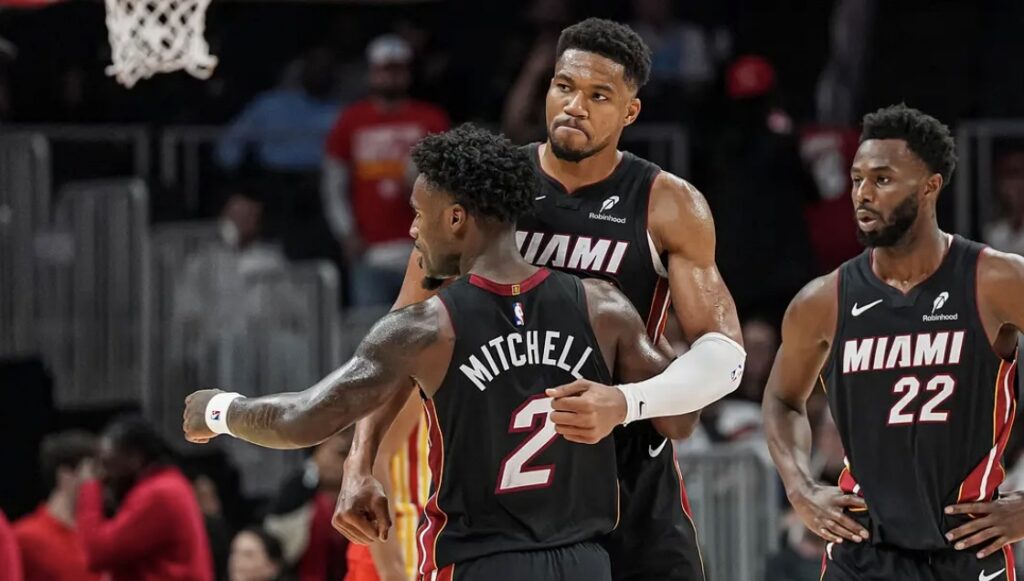
The Miami Heat finished their five-game Western Conference trip with two straight wins, but the second was nothing like an offensive masterpiece. On November 10, Miami beat the Utah Jazz 115-109 while shooting just 39.3% from the field and 29.3% from three-point range. Utah made a late push, outscoring the Heat 37-23 in the fourth quarter. Miami survived anyway.
That matters because Erik Spoelstra had just made his first major lineup adjustment of the 2026-27 season. Pelle Larsson replaced Andrew Wiggins in the starting five against Sacramento and kept the spot against Utah. Two wins do not establish a permanent solution, especially against two struggling opponents. They do, however, give the Heat a useful early test of what this roster looks like when its priorities are defense, connectivity and enough shooting rather than simply squeezing more names into the lineup.
A Rotation Change That Says More Than the Score
Miami opened the season 0-4, then won five of its next seven games to reach 5-6. The victories over Sacramento and Utah closed the road trip at 3-2, an improvement but hardly a reason to declare every problem solved. The question worth asking is what changed in the way the Heat assembled their possessions.
As Hot Hot Hoops reported in its analysis of Spoelstra’s starting-lineup decision, the coach described Larsson as a connector who supplies energy and toughness. That is a revealing description. Miami already has Giannis Antetokounmpo to attack the rim and Bam Adebayo to defend, screen, pass and finish. Adding another player who needs touches is not automatically helpful. Adding someone who makes the next pass, stays involved away from the ball and completes the defensive assignment can be.
Against Sacramento, Larsson scored 11 points and hit three of four attempts from beyond the arc in his first start of the season. Against Utah, he provided 14 points, seven rebounds and two made threes in just over 31 minutes. The shooting was welcome, but the minutes tell a broader story: Spoelstra trusted the third-year wing to occupy a meaningful role alongside his most established players in two consecutive road wins.
The Giannis and Bam Partnership Needs the Right Players Around It
When Miami acquired Antetokounmpo before the season, the most obvious basketball question was not whether he and Adebayo could defend. It was how a roster with two dominant interior players would keep sufficient space for cuts, drives and kick-outs. The NBA’s season preview identified that concern directly while noting the team’s collection of veteran shooters, including Klay Thompson, Tim Hardaway Jr. and Bobby Portis.
There is a temptation to judge spacing by counting made threes in one box score. That misses the larger issue. A defender must respect where a shooter stands, and the player occupying that space must react when help rotates toward Giannis. Larsson does not need to turn into a high-volume marksman overnight. He needs to be available as an outlet, make decisions promptly and avoid stopping the possession when the ball finds him.
The Utah game demonstrated why that can matter even on a poor shooting night. Antetokounmpo scored 30 points on 12-for-21 shooting and grabbed 11 rebounds. Davion Mitchell added 19 points and eight assists. Adebayo scored only 11, making one of eight field-goal attempts, yet contributed three steals and two blocks. Those contributions are not interchangeable, but together they show how Miami can win with different players carrying different pieces of the game.
The Heat also committed only eight turnovers, compared with Utah’s 18, according to the official NBA game record. Possession security helped compensate for missed shots. That is a more sustainable feature to build around than hoping everyone makes half their threes. An offense that protects the ball can keep generating opportunities; an offense that gives away possessions has to work much harder to survive an off night.
Wiggins Off the Bench Is a Test of Depth, Not a Verdict
Moving Wiggins to the second unit inevitably creates a headline because of his résumé. The veteran has been an All-Star, an NBA champion and a significant contributor on both ends of the floor. But rotation decisions are about fit and current performance, not a permanent ranking of careers.
The early results suggest there may be a more productive way to use him. Against Utah, Wiggins scored 13 points on five-for-eight shooting in 18 minutes and 32 seconds off the bench. It was one game, not proof that a new role has fixed his shooting or defensive issues. Still, it raised a practical possibility: second-unit minutes might let Wiggins attack different matchups rather than spending every shift sharing the floor with two ball-dominant frontcourt stars.
A successful bench role would also protect Miami from asking too much of Larsson. The new starter can concentrate on linking the offense and defending his assignment, while Wiggins provides another scoring option when the rotation staggers. Those jobs overlap, but they are not identical. Spoelstra’s task is to find combinations in which neither player is forced into a role that exposes his limitations.
Why Minutes and Roles Matter Beyond a Two-Game Streak
The Heat’s lineup shuffle offers a reminder that counting statistics rarely tell the entire story of an NBA player’s value. Larsson can help Miami by deflecting a pass or keeping a possession alive without receiving credit for a point or assist. At the same time, fantasy basketball managers have to make decisions from measurable categories: points, rebounds, assists, steals, blocks, shooting percentages and availability.
That distinction makes playing time especially important. Anyone comparing updated nba fantasy rankings with a player’s preseason outlook should pay attention to role changes such as Larsson’s promotion and Wiggins’ move to the bench. RotoWire’s rankings allow users to adjust formats and scoring categories, which is useful because the same player can have different value in points-based and category-based leagues. Rankings are a reference point, not a guarantee of what the next box score will show.
For Miami fans, the same lesson applies without fantasy stakes. A 14-point night from Larsson matters differently if it comes with starter-level minutes, a defensive assignment against a quality wing and possessions that keep Giannis involved. Conversely, a higher-scoring performance can conceal missed rotations or empty trips. The Heat need contributions that fit together, not simply five players who can put up numbers separately.
The Next Test Is Stronger Opposition and a Full Homestand
The NBA’s Utah recap noted that the Heat returned home to face Cleveland on Friday, November 13, opening a five-game homestand. That presents a better opportunity to evaluate the change over multiple opponents rather than two games at the end of a road trip. Spoelstra will see whether Larsson can maintain his defensive activity, whether Wiggins continues to contribute against reserves and how the team responds when opponents take away its preferred actions.
The key development is that Spoelstra has started prioritizing how the pieces work together over which players carry the biggest names. Larsson’s starting spot may change again, and Wiggins may eventually reclaim it. What should remain is the standard behind the decision: the Heat need lineups that protect the ball, cover for each other and create enough room for their stars to do what they do best. Two November wins cannot settle that question. They can show Miami where to look for the answer.
***
To check out our other content, click here.
Follow Hot Hot Hoops on Twitter/X here!
Follow Hot Hot Hoops on Instagram here!
Subscribe to our YouTube channel here!
- Heat’s Adam Simon may have done it again with recent draft choice
- Miami’s new starting five won without hot shooting. Can that formula last?
- 3 winners, 1 loser from Heat’s fifth straight win against Rockets
- 3 former Heat players discuss emotions ahead of their return to Miami this week
- Heat’s Klay Thompson is rapidly approaching all-time great for this milestone