
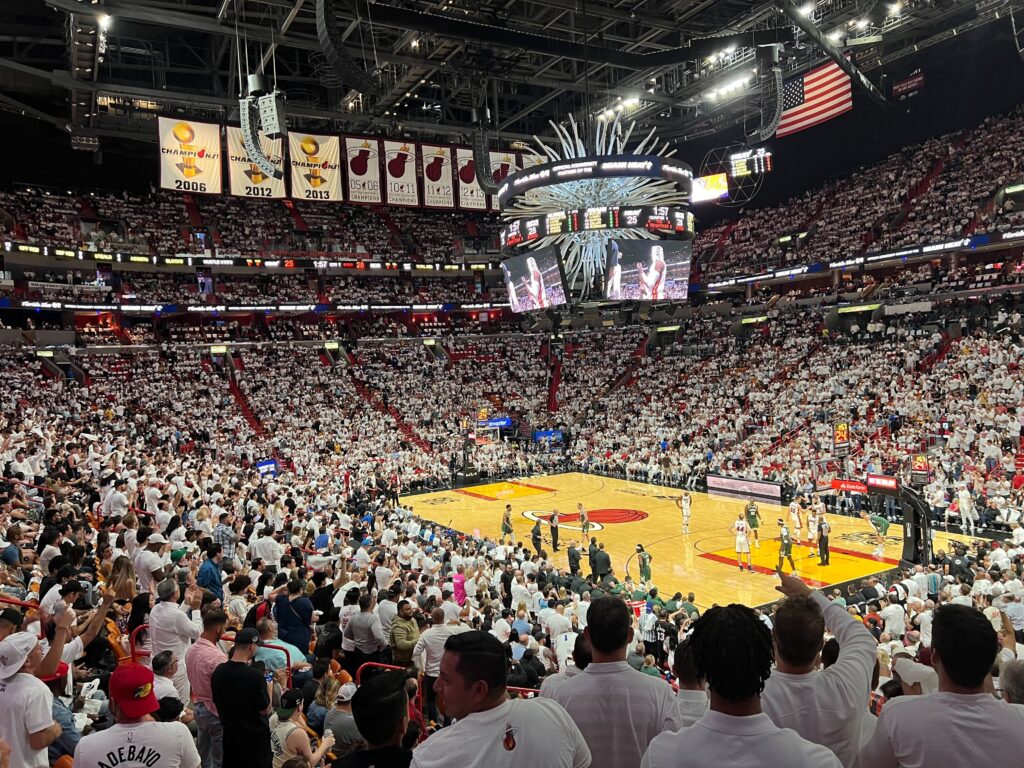
There are certain phrases around professional sports that start as marketing slogans but eventually lose meaning. Whether it’s “defending the land” in Cleveland or “fearing the deer” in Milwaukee, it’s a catchy albeit temporary way to connect with fans and unite them.
“Heat Culture” has somehow done the opposite.
What started as a standard built inside the Miami Heat organization has become one of the most recognizable identities in the NBA, one that has signified a mantra of excellence over the years. It represents conditioning, accountability, sacrifice and an expectation that every player who enters the building commits to something bigger than individual success. If they can’t commit to that high standard, players won’t stick around for long.
Across different eras, different rosters and different superstars, the Heat have found ways to remain relevant because the foundation and expectations rarely change. This is what attracts superstars to the franchise and how the front office identifies role players such as Davion Mitchell that can flourish here.
Since Pat Riley arrived in Miami in 1995, the franchise has transformed from a young expansion team into one of the league’s most respected organizations. The Heat have captured three NBA championships, made seven NBA Finals appearances and consistently remained competitive despite the natural roster turnover every team experiences.
The reason has always been bigger than one player, moment, or movement.
Pat Riley established the foundation
Before Miami became known as a destination for stars, Riley had to create a standard for this Heat Culture. The young franchise needed a template for success, and they turned to a legend with a track record of success.
After building championship teams with the Los Angeles Lakers and later coaching the New York Knicks, Riley brought a different mentality to South Florida. The goal was not simply to make the Heat competitive, it was to build an organization that expected to compete every season.
That vision started with preparation.
Riley dreamed of a parade down Biscayne Blvd and he acted immediately on that vision by acquiring his franchise cornerstone, his enforcer, in a trade with the Charlotte Hornets to acquire Alonzo Mourning.
Miami soon became known for demanding conditioning tests, attention to detail and a commitment level that was not necessarily for every NBA player. Over time, that reputation became part of the team’s identity.
The Heat were not always the most talented roster in the league, especially early, but opponents would soon rarely question their preparation.
That Heat Culture mindset helped define the Mourning and Tim Hardaway era, carried into the Dwyane Wade years, as well as the Big 3 era with LeBron James and Chris Bosh, and continued through every major chapter that followed.
Championships validated the vision
Every organization wants to build a winning culture, but championships are what separate a philosophy from reality.
Miami’s first breakthrough came in 2006 behind Wade’s superstar rise and Shaquille O’Neal’s arrival in a trade with the Los Angeles Lakers. The Heat captured their first championship and proved Riley’s aggressive approach to team-building could deliver results.
Years later, the Big Three era elevated the franchise to another level.
When LeBron James and Chris Bosh joined Wade in 2010, Miami became the center of the basketball world. The Heat reached four consecutive NBA Finals and won back-to-back championships in 2012 and 2013.
While those teams were being built around elite talent, the organization’s structure helped maximize it.
Miami surrounded its stars with veterans willing to embrace specific roles, from Shane Battier and Mike Miller to Udonis Haslem and Ray Allen. Everyone understood the expectations.
The jersey mattered as much as the name on the back.
Heat Culture survived beyond superstars
The true test of any organizational identity comes after the stars leave.
After James returned to Cleveland, Bosh’s career was cut short because of health concerns and Wade eventually moved into the final stages of his career, Miami entered what could have become a long rebuild.
Instead, the Heat largely remained competitive and refused to tank.
That reputation only strengthened during the Jimmy Butler era.
Butler arrived in 2019 as a player who perfectly represented everything Miami valued. His competitiveness, toughness and willingness to embrace difficult situations immediately matched the organization’s personality.
The results followed.
Miami reached the NBA Finals in 2020 and again in 2023, with the second run becoming one of the greatest examples of Heat Culture in action. The Heat became just the second No. 8 seed in league history to reach the Finals, eliminating higher-seeded opponents behind preparation, adjustments and unexpected contributions throughout the roster.
Players like Caleb Martin, Duncan Robinson, Gabe Vincent and Max Strus became examples of Miami’s ability to find and develop talent overlooked elsewhere.
Miami’s identity keeps expectations alive
Part of what makes the Heat unique is how difficult they are to evaluate from the outside.
Traditional measurements do not always explain Miami’s success. Regular-season records, roster rankings and projections often fail to capture how dangerous the Heat can become when the postseason arrives.
That unpredictability has created significant interest around Miami whenever playoff conversations begin. Fans tracking league projections, championship markets and team expectations throughout the season can compare different information and available offers through Odds Scanner US as the Heat continue trying to outperform outside predictions.
Whether Miami enters a season as a favorite or an underdog, the organization believes its standards give it a chance.
The next chapter of Heat Culture
The NBA constantly changes from season to season.
Teams rebuild. Stars move. Playing styles evolve.
Miami’s challenge moving forward is proving Heat Culture can continue producing results in a league where talent acquisition has become more competitive than ever while free agency is largely a thing of the past.
The next version of the Heat will need more than toughness and preparation. It now has the superstar centerpiece the franchise spent years searching for in Giannis Antetokounmpo. With Giannis joining Bam Adebayo to form one of the NBA’s most formidable foundations, Miami has officially entered a new championship window—one that could define the final chapter of Pat Riley’s illustrious career.
But the foundation remains.
From Riley to Erik Spoelstra, from Tim and Zo, from Wade heading the Big 3, to Butler’s relentlessness in the postseason, and now the present with Bam and Giannis. From championship teams to unexpected playoff runs, Miami has built something few franchises can genuinely claim.
An identity.
Players change. Expectations do not.
That is why, nearly three decades after Riley arrived in South Florida, Heat Culture remains one of the NBA’s strongest winning brands.
***
To check out our other content, click here.
Follow Hot Hot Hoops on Twitter/X here!
Follow Hot Hot Hoops on Instagram here!
Check out Hot Hot Hoops on Facebook here!
Subscribe to our YouTube channel here!
- Ryan Conwell brings shooting, confidence and a familiar work ethic to the Heat
- Giannis Antetokounmpo and Bam Adebayo plan to make each other better — starting in practice
- Klay Thompson on joining Heat: “I want to be tested. I want to be pushed.”
- Giannis Antetokounmpo reveals which Heat players caught his eye this summer
- Heat’s Giannis Antetokounmpo: ‘I don’t care about being best, I care about being a winner.’
- Heat vs Knicks 2026–27: Matchups, Futures and the East’s Renewed Rivalry
- Report: Heat expected to sign veteran guard to training camp deal
norms gone most likely anferne simons would be my choice not sure we have enough $$$ for him/
Hield off the board. Ziare Williams now is a free agent.
zaire williamSON would be nice
I think it would be more poetic justice if the Warriors trade quitter after he said ‘it’s nice to be somewhere that I’m wanted’. Of course, he says that every place he goes until things sour.
can gsw get lbj and ad w/o trading quitter and keep draymond to i hope not.they would win it all with all those guys.
ramond declining his option talking goat and ad going to gsw apron man please help that not happen
dramond
I’m not sure what Heat Culture is anymore. Claiming to outwork your opponents is great, but if the results are 8 seeds, did that work really matter?
Really Heat culture is chasing whales and hoping they can carry the franchise to titles.
I know the NBA has changed, but this tough guy identity they want to sell falls flat when the team often has no back-bone. Bam gets hurt on a dirty play, did anyone on Miami up the physicality to return the favor? Anyone on Miami get mad when they are getting blown out and commit a hard foul? These things don’t happen anymore, so stop acting like being in shape is great. Having the leagues best cross fit squad, doesn’t translate to wins.
My memory reminds me of the ECF and Finals appearance where the big storyline was how many undrafted guys were contributing and/or starting. It got Strus and Vincent paid. I think that alone speaks volume of the culture.
ss playoff jimmy was that good
He was great but don’t kid yourself. Jimmy could not do it alone. Martin should have been ECF MVP. That’s an example.
they were both great true
They do get the most of the guys they have, but they rarely have the guys they need. Culture of getting the most out of low level guys also devalues all players on the team. No one thinks they’ll get anything out of the players Miami has.
If they are valuable to you and play a role for the Heat that’s all we can ask for. It will be the same now with the Giannis build. They will absolutely need more guys that pop like that at a discount. Other teams can worry about paying them or not once let go.
Heat Culture hasn’t produced a championship in 12 years. Getting to the NBA Finals as an 8th seed is a moral victory. However, the objective in basketball, as it is in boxing, is to be a champion, not just a contender.
Is Heat Culture years of mediocrity followed by an attempt at relevance by trading away the team’s future? Trying to jump to the head of the line with one move, sounds more like an act of desperation.
If a poker player who is slowly building up his stack of chips decides to bypass the winning process and push them all to the middle of the table on one hand and doesn’t win, he is considered a loser.
The same goes for the NBA. If the Heat wins the championship as the result of the Giannis trade, it will be considered a great success. If the Heat falls short, it will be considered a complete failure.
Unfortunately, if that happens, there will be no pieces remaining to pick up and rebuild the team for the next 5-6-7 years. They will all be in Milwaukee, Pat Riley will be retired and Heat fans will be more disgruntled than ever.
I’m with him ⬆️
its worth the risk
It is definitely worth the risk and if it fails Maybe pat will finally retire and we could sell bam and giannis to the highest bidders.
Sounds like an airtight plan. What could go wrong? Worst case scenario, Heat can then become the 2026 Bucks without a core group to build upon.
Having a culture & identity is great… but please remove all those silly sayings about being the toughest & nastiest team in eternity plastered everywhere. Talk about firing up the opposition without really trying! Keep all that between the lines by action not just words.
u mean they werent afraid of going to the rim with ty n dunc there.u know nothing
Both you and Zac’s comments are somewhat valid. You can’t just talk the talk, after awhile words become hollow. And yes, being fit may not be everything, but it can be the difference when talent is close to equal. I thought the Indiana team of two years ago overplayed its talent level and went as far as their talent could take them on sheer fitness, for example.
ss hali is supe rtalented.just need one ss we have him now yah
Exactly. Talk is cheap.
The Heat may be moving towards even more glory now. What was wrong with this team has been fixed.
Today is a big day, the Wiggins situation should become clear. I know it’s a long shot, but if we kept Andrew and Norm, maybe add one more piece like the Grimes suggestion many have suggested, I like this team to go deep into the playoffs, barring injuries.
Let the building excitement continue. No question in my mind we are heading in the right direction for this team, for what we had and where we were, going forward.
Go Heat!
heat culture was riley getting his team in unbelieveable shape sort of like shula did.ultimately getting d wade reinforced that.
Save this article until after they win #4.
isnt it one for the thumb .hardens inepittude.wades miraculous series versus dallas.big 3 got 2or just 1.rayallen shot vs spurs was there another one maybe not